Skip to contentFarm Fresh
to Market
Request produce
Menu

Farm Fresh to Market / Inside the journey

Follow the produce.
Discover every step.

Follow grape tomatoes from the vine to dispatch, or start at the supplier’s dock with produce already in cases. Choose a product to see its handoffs.

Growing program

Grape tomatoes

Maguan Tropical’s documented protected-agriculture program is based in San Juan de la Maguana, with grape tomatoes as its principal crop. Confirm the growing source and availability for each order.

Current handoff On the vine

SELECTED PRODUCEGrape tomatoes

24 products

Request this produce ↗

WATCH THE PROCESS

Grape tomatoes from vine to dispatch

AI-generated workflow illustration.

0:00—:—

THE PRODUCE / FIVE STAGES

Follow the grape tomatoes.

From the growing reference to the buyer’s table. Inspect the grape tomato itself at every stop.

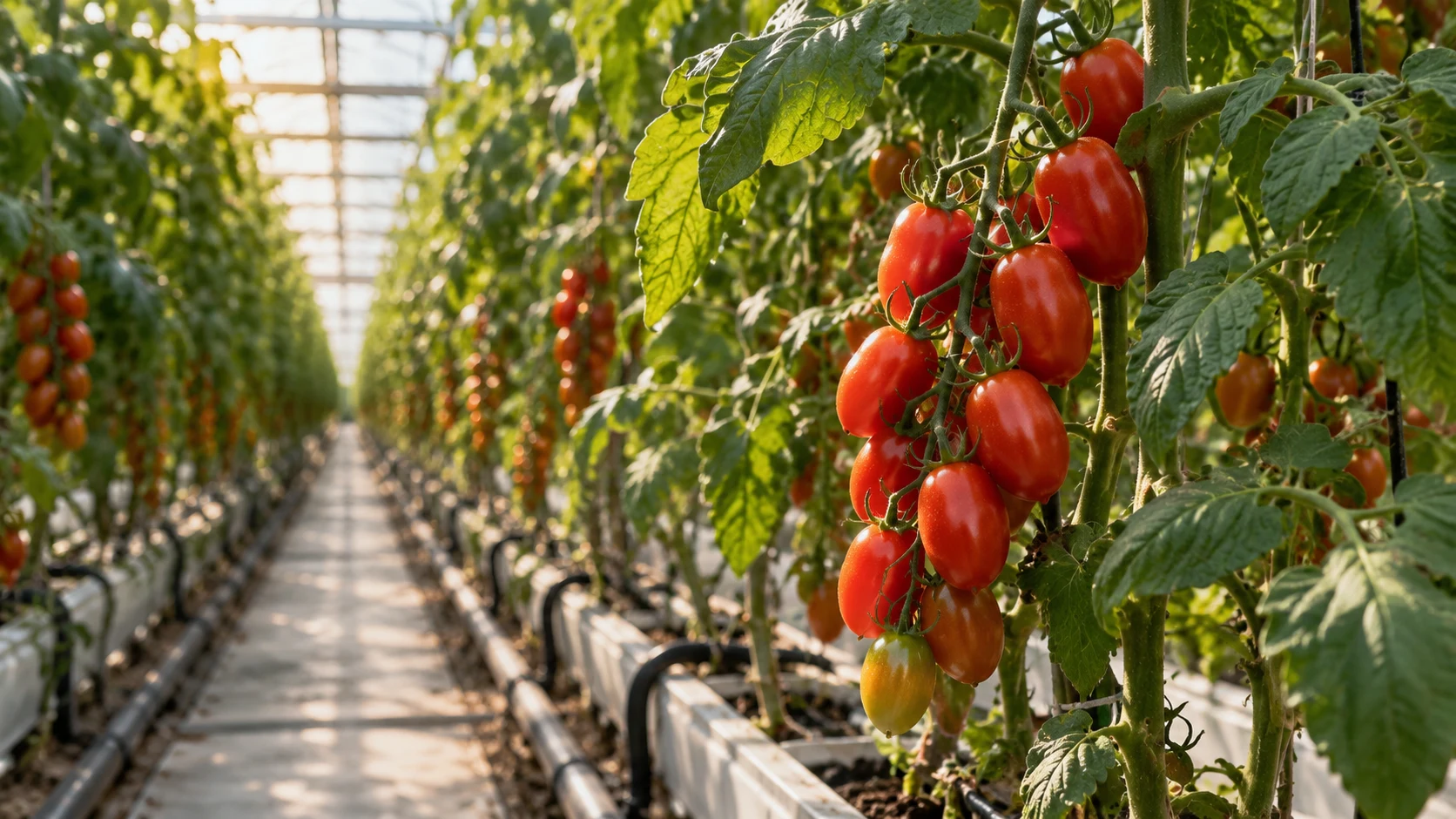
Ripe grape tomatoes hanging in a greenhouse row
Illustrative crop journey

Choose 3D to turn and inspect the actual produce form. Drag to rotate; pinch or use the controls to zoom.

01 / GROW

Grape tomatoes
Grow, in context.

Elongated fruit develops on a supported tomato plant. Maguan Tropical’s documented grape-tomato program is the growing reference here.

The local growing reference is Maguan Tropical’s grape-tomato program in San Juan de la Maguana. The illustration explains the crop; it is not a view of a measured production lot.

Request grape tomatoes ↗
1 / 5
Product details & sourcing

Small, oblong tomatoes for salads, snacking and prepared dishes.

San Juan grape-tomato growing program
Confirm origin for your order

Variety, origin, pack, availability and delivery arrangements are confirmed for your order.

Compare growing options & costs ↓

FARM INFRASTRUCTURE / GROWING POTENTIAL

Where could grape tomatoes grow?

Compare three trial setups for this crop. The figures start with a common worked example and a historical New York electricity rate. Enter your own trial measurements, supplier quotes and buyer specifications to compare the sites.

Trellised fruiting crop

01 / Dominican Republic

San Juan de la Maguana

Ventilated protected rows

Compare a high-wire or supported crop with drip irrigation and airflow sized for warm conditions.

Use the documented local grape tomato program as a reference. Check the parcel’s water supply, heat, rainfall and drainage for the selected crop. Maguan Tropical’s tomato program ↗

Saleable output
2,550 kg/yr
Annual revenue
$6,375
Annual cost
$5,693
Break-even price
$2.23/kg

02 / Dominican Republic

Constanza

Protected valley trial

Start with a trellised tunnel bay. Track night temperature, condensation and disease pressure.

The Ministry of Agriculture lists potatoes, onions, carrots, tomatoes and bell peppers among Constanza’s crops. Check the selected parcel for crop fit, moisture, access and packing distance. Dominican Ministry of Agriculture ↗

Saleable output
2,550 kg/yr
Annual revenue
$6,375
Annual cost
$5,693
Break-even price
$2.23/kg

03 / Controlled trial

New York

Heated greenhouse pilot

Compare a seasonal tunnel with a heated bay. Measure winter canopy light and heat demand before sizing either.

Price the controlled environment against the seasonal alternative. At JFK, the 1991–2020 outdoor January mean was 32.8°F (0.4°C). Use the actual site’s weather, canopy light and utility rates for a design. NOAA’s JFK climate normals ↗

Saleable output
2,550 kg/yr
Annual revenue
$6,375
Annual cost
$5,722
Break-even price
$2.24/kg
Change the example numbers

The starting yield and costs are demonstration inputs, with the New York electricity rate taken from EIA. The example covers a full production year in USD. Record cultivar, planted area, fruit set, marketable grade and labor for trellising and harvest.

San Juan de la Maguana · Annual balance after modeled costs $683

How the comparison works

Usable area × annual harvest per m² gives harvested kilograms. Apply the saleable share, then multiply by sale price to find annual revenue.

Annual cost adds electricity use × rate, separate heating fuel, labor, growing inputs and land, packaging and delivery per saleable kilogram, and the annual facility allocation. Break-even divides annual cost by saleable kilograms. No break-even price appears at zero saleable output.

Include financing, taxes, insurance and losses in the applicable inputs for your trial. Add capital and establishment years separately before comparing investments.

New York’s 2025 statewide commercial electricity average was 20.97¢/kWh. Use a site tariff to include actual delivery and demand charges. Cornell’s high tunnel work describes seasonal protection, and its controlled environment agriculture program discusses the added cost of light.

Explore the eight-stop grape-tomato story ↗

Farm Fresh to Market / THE GROWING STORY

Rooted in a place.
Connected by intelligence.

Explore the San Juan growing program and the AI-assisted growing system from Forem Labs.

PLACE / PROGRAM / POSSIBILITY

A growing program has a place.

Explore our San Juan reference and the northern grape-tomato venture. Keep each crop, place and stage of development connected.

Loading Earth imagery…
EARTH / REGIONAL REFERENCES

Drag to explore · scroll or pinch to zoom
Use the region buttons for a keyboard-accessible view.

SELECTED PRODUCE Grape tomatoes

DOMINICAN REPUBLIC · REGIONAL REFERENCE

Rooted in San Juan.

Maguan Tropical’s documented protected-agriculture program is based in San Juan de la Maguana, with grape tomatoes as its principal crop. Confirm the growing source and availability for each order.

18.81° N / 71.23° W · municipal reference. Neither marker identifies a farm parcel.

Explore Maguan Tropical
Grape tomatoes: a documented program, with order origin to confirm.

The San Juan program is the growing reference for this crop. The map does not identify the farm or country for a specific WUHL order. No growing radius or shipping route is implied.

Map imagery & regional references

Earth imagery: NASA / GSFC Blue Marble Next Generation, Reto Stockli. August 2004 composite, resized for display; not live weather, current crop cover or a farm survey.

San Juan reference: municipal development plan. Northern New York: a coarse planning marker within the North Country region, not a confirmed facility location. Program information: Maguan Tropical.

Growing, sourcing & future ventures
01 / LOCAL GROWING

Grape tomatoes

Maguan Tropical’s documented protected-agriculture program is based in San Juan de la Maguana, with grape tomatoes as its principal crop. Confirm the growing source and availability for each order.

Meet the San Juan growing business ↗
02 / POSSIBLE FUTURE CROPS

Assess before planting.

Additional crops are possibilities to investigate, not a verified local planting list. Variety, season, site conditions, water, equipment and buyer demand need a local feasibility review.

Discuss a local crop trial ↗
03 / SOURCED PRODUCE

A crop name is not an origin record.

WUHL’s grape-tomato range and Maguan Tropical’s growing program are distinct facts. The actual source and availability are confirmed for each order.

Explore the WUHL supply range ↗
04 / NORTHERN PROJECT

New York · Planned venture

A planned New York grape-tomato greenhouse builds on the San Juan reference. Compare crop-stage targets, local daylight, winter heating and irrigation before a northern trial.

Explore the northern plan ↗

Local program sources: Company history ↗ · Tomato portfolio ↗. Company-reported program; confirm current crop and supply details.

MATEO / FFM.CO

Maguana Tropical

Watch the continuous explanation · 38 seconds

Continuous visual explanation · Mateo’s original narration with AI illustrations. This is a narrated visual film, not a speaking-avatar recording.

Mateo · AI narration for FFM.CO

Read the explanation

I'm Mateo, your guide to FFM.CO. Maguana Tropical is the protected-agriculture business in San Juan de la Maguana, in the Dominican Republic, with grape tomatoes as its principal crop. This page looks at the growing environment and the journey from crop to a commercial supply program. A buyer's brief connects dates, weekly volume, grade, packaging, and destination. Current availability, export arrangements, and audit documents need confirmation. The greenhouse model explains the work without promising a harvest or a financial result.